

3DLabPrint Coupons, Promo Codes & RC Aircraft Deals
The Ultimate 3DLabPrint Master Guide: 3D-Printable RC Aircraft, STL Files, Slicer Optimization & Coupon Savings (2026)
1. Introduction: The Revolution of 3D-Printed Radio-Controlled Aviation
Radio-controlled (RC) model aviation has undergone a profound technological transformation over the past decade. Traditionally, building a scale model warbird or aerobatic glider required hundreds of hours of delicate craftsmanship—cutting balsa wood, applying iron-on heat shrink film, or laying fiberglass composite in expensive silicone molds. If an aircraft crashed during its maiden flight or suffered structural failure during high-G maneuvers, repairing or rebuilding the fuselage often meant starting entirely from scratch or purchasing expensive factory replacement airframes.
Enter 3DLabPrint, a pioneering aerospace engineering group founded by veteran aircraft designers and passionate RC pilots based in the Czech Republic. 3DLabPrint fundamentally disrupted the RC hobby industry by developing fully 3D-printable model plane STL files specifically optimized for standard desktop FDM (Fused Deposition Modeling) 3D printers. By leveraging additive manufacturing, 3DLabPrint empowered hobbyists, makers, and aviation enthusiasts across the globe to print high-performance scale fighter planes, electric ducted fan (EDF) jets, civil trainers, and gliders in their own homes for a fraction of the cost of traditional composite kits.
Today, with over 1,850 verified pilot reviews and a massive global community of 3D printing aviators, 3DLabPrint remains the gold standard in printable aeromodeling. Whether you are looking to assemble the legendary Hawker Tempest Mk II Value Pack, take to the skies with the swept-wing A-7 Corsair II EDF Jet, or rocket through high-speed aerobatics with the historic Me 163B Komet, 3DLabPrint delivers unmatched structural fidelity, scale aesthetics, and precise flight dynamics.
2. Breakthrough Thin-Wall Internal Structural Technology
What makes 3DLabPrint models stand apart from standard 3D printed objects is their proprietary single-wall thin-skin structural architecture. Standard 3D prints rely on multi-wall perimeters and dense internal infill patterns (such as grid or cubic infill), which add immense weight—rendering standard 3D prints far too heavy to generate sufficient aerodynamic lift for stable RC flight.
3DLabPrint's aerospace engineers solved this weight-to-strength bottleneck by designing models that print using a single continuous wall extrusion perimeter (typically 0.40mm to 0.42mm thick) combined with intricate internal ribbing, wing formers, and spar channels embedded directly into the STL 3D mesh. When sliced in popular software like Cura, PrusaSlicer, or Simplify3D, the printer nozzle traces the outer aerodynamic skin and smoothly transitions into internal diagonal bracing without lifting the print head or creating unnecessary retractions.
Key Benefits of 3DLabPrint Engineering:
- Ultra-Light Airframe Weight: Single-wall extrusion eliminates unnecessary plastic, providing optimal wing loading comparable to balsa wood models.
- High Torsional Rigidity: Internal diagonal ribbing acts like real aircraft wing spars, withstanding high aerodynamic G-loads during power loops and high-speed rolls.
- On-Demand Part Replacement: Damaged wing tips or nose sections can be re-printed independently in hours for pennies in filament cost.
- Pre-Modeled Control Hinges & Alignment Pins: Control surface hinge slots, motor mounts, and carbon spar alignment guides are pre-engineered into the digital mesh.
3. Comprehensive 3DLabPrint Aircraft Model Lineup
3DLabPrint offers a diverse catalog of scale model aircraft tailored for beginner RC pilots, scale warbird enthusiasts, and high-speed EDF jet speed demons. Below is a detailed breakdown of the premier model categories available:
A. Scale WWII Warbird Series
World War II fighter planes represent the flagship category of 3DLabPrint. These models feature scale cowl contours, authentic panel line details, optional retractable landing gear mounts, and removable canopy hatches for quick battery swaps.
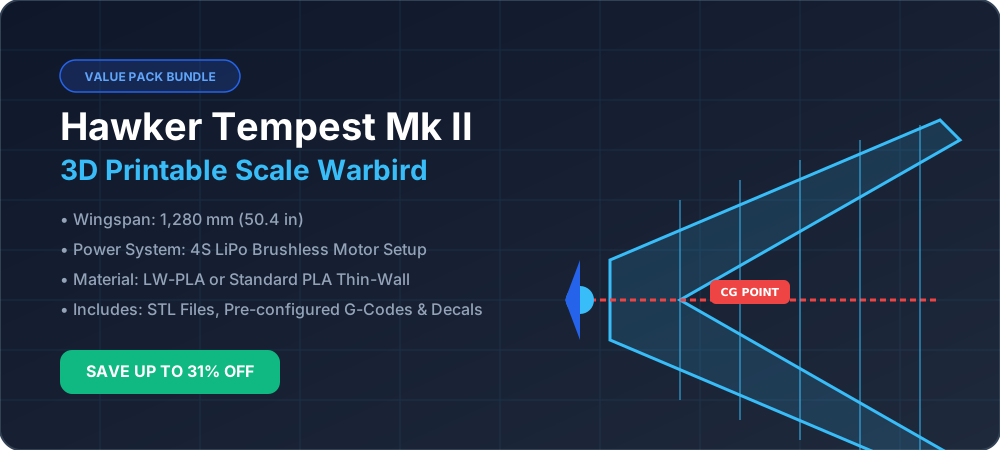
- Hawker Tempest Mk II & Value Pack: The Hawker Tempest Mk II is an iconic British late-war radial engine fighter known for its incredible speed and heavy firepower. The 3DLabPrint Tempest features a wingspan of 1,280mm (50.4 inches) and is designed for 4S LiPo power systems. The Hawker Tempest Mk II Value Pack includes complete STL files, scale decal templates, printable G-codes, and high-resolution assembly PDF documentation at a bundled discount of up to 31% OFF.
- Supermarine Spitfire Mk XVI: Designed with elliptical wing geometry, the 3DLabPrint Spitfire replicates the flight characteristics of the famous RAF defender. It offers smooth stall handling and high maneuverability.
- North American P-51D Mustang: Featuring the legendary belly radiator scoop and bubble canopy, the P-51D is engineered for scale warbird air racing and fast low-passes.
- Messerschmitt Bf 109T & Vought F4U Corsair: German and American carrier warbirds built with reinforced carbon wing joiners to withstand aggressive aerobatic maneuvers.
- Polyikarpov I-16: A compact, ultra-agile Soviet WWII fighter model featuring short wingspan roll rates and responsive elevator controls.
B. Electric Ducted Fan (EDF) Jet Series
For speed lovers seeking jet turbine sound dynamics and high-velocity flybys, 3DLabPrint EDF jet models deliver exhilarating performance:
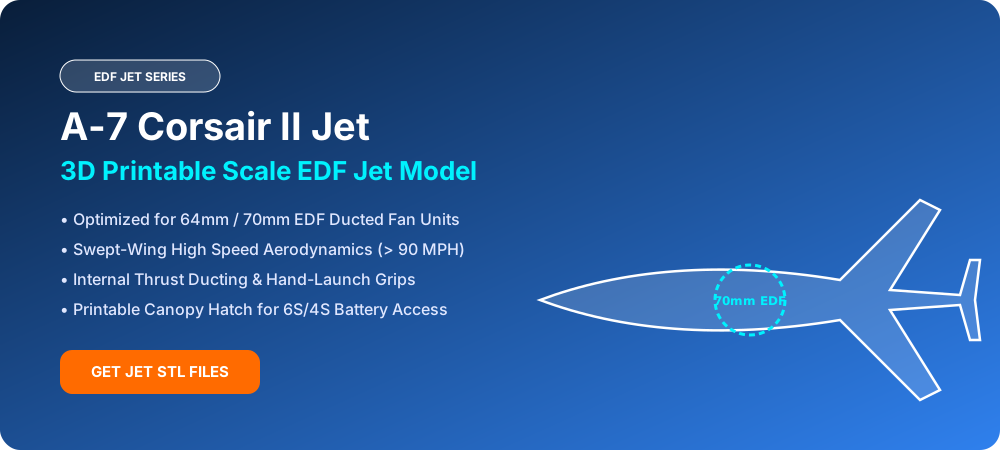
- A-7 Corsair II EDF Jet: Modeled after the US Navy attack jet, the A-7 Corsair II features an optimized internal thrust duct designed for 64mm or 70mm EDF fan units. Its swept wings and low intake drag allow top speeds exceeding 90 MPH while maintaining stable hand-launch characteristics.
- MiG-15 & L-39 Albatros: Classic early jet age fighters featuring authentic air intake scoops and straight-pipe exhaust ducting for maximum brushless motor thrust efficiency.
- F-86 Sabre: The American counterpart to the MiG-15, engineered for smooth high-speed swept-wing tracking and stable belly landings.
C. Civil Aviation, Trainers & Thermal Gliders
Beginner pilots and thermal soaring enthusiasts will find gentle flight profiles among 3DLabPrint's civil aviation series:
- Piper J-3 Cub: A high-wing scale civil aircraft with self-righting dihedral stability, forgiving stall behavior, and ultra-slow landing speeds—ideal for first-time 3D-printed plane pilots.
- EasyTrainer & Q-Trainer: Purpose-built trainer models equipped with top-mounted pusher propellers to protect motor shafts during rough belly landings on grass fields.
- Me 163B Komet: A historic rocket interceptor design offering incredible gliding efficiency once power is cut, combining rapid rocket-like climbs with extended thermal soaring capabilities.
4. Advanced 3D Printing Materials: LW-PLA vs. Standard PLA vs. PETG
Selecting the right 3D printing filament is critical to achieving lightweight airframe targets and long-term durability. Here is an in-depth material comparison for 3DLabPrint models:
| Filament Type | Density / Weight | Print Temp | Key Advantages | Best Application |
|---|---|---|---|---|
| LW-PLA (Active Foaming) | 0.60 – 0.65 g/cm³ (50% lighter) | 230°C – 245°C | Massive weight savings, lower stall speeds, easy to paint & sand | Main wing panels, tail surfaces, fuselages |
| Standard PLA / PLA+ | 1.24 g/cm³ | 205°C – 220°C | High tensile strength, rigid surface finish, crisp layer printing | Motor mounts, firewall battery trays, control horns |
| PETG | 1.27 g/cm³ | 235°C – 250°C | High heat deflection (summer hot cars), flexible impact resistance | Landing skids, belly protection plates, EDF duct mounts |
| TPU (Flexible 95A) | 1.21 g/cm³ | 220°C – 235°C | Virtually indestructible elastic flexing, tear resistant | Control surface hinges, scale tires, nose cones |
Pro Tip for LW-PLA Foaming: Active foaming LW-PLA expands up to 200% inside the hotend when heated above 230°C. When using LW-PLA profiles on 3DLabPrint files, reduce your slicer flow rate (extrusion multiplier) to approximately 50%–55%. This produces a lightweight micro-foamed wall that drastically lowers aircraft wing loading while retaining structural stiffness.
5. Master Slicer Configuration & 3D Printer Setup

To guarantee pristine thin-wall prints with zero stringing and perfect layer adhesion, adhere strictly to 3DLabPrint's recommended slicer profiles in Ultimaker Cura, PrusaSlicer, or Simplify3D:
- Nozzle Diameter: 0.40mm standard brass or hardened steel nozzle.
- Extrusion Width / Line Width: Set precisely to 0.40mm (or 0.42mm for reinforced root wing sections).
- Layer Height: 0.25mm or 0.20mm. 0.25mm provides optimal layer strength and faster print times.
- Wall Perimeter Count: 1 single wall perimeter (0.40mm thick). Do NOT use 2 walls unless explicitly directed by the manual for motor mounts.
- Infill Percentage: 0% infill. The internal diagonal ribbing in the STL file acts as structural internal infill automatically.
- Bottom / Top Layers: Set top layers to 0 for open rib wing tubes, and bottom layers to 1–2 for solid root ribs.
- Print Speed: 40mm/s to 50mm/s for PLA; 30mm/s to 40mm/s for LW-PLA foaming material.
- Cooling Fan Speed: 0% to 20% max for standard PLA to maximize inter-layer chemical bonding. For LW-PLA, keep cooling fan at 0% throughout the print.
- Minimum Printer Build Volume: 200mm x 200mm x 200mm (compatible with Ender 3, Prusa MK3S, Bambu Lab X1/P1P, Creality K1, Anycubic Vyper, Artillery Sidewinder, etc.).
6. Electronics, Motors, Servos & LiPo Power Setup
Completing your 3DLabPrint aircraft airframe requires matching the recommended brushless power system and radio control electronics. Here is a baseline hardware setup guide:
- Brushless Outrunner Motor: 3536 to 3542 800KV–1000KV motors for 1,200mm+ scale warbirds (like the Hawker Tempest Mk II); 2212 1400KV–2200KV motors for smaller park flyer models.
- Electronic Speed Controller (ESC): 40A to 60A ESC with 5V 3A BEC output for warbirds; 60A to 80A ESC for high-thrust 70mm EDF jet units.
- Micro Servos: 9g metal-gear (MG90S or EMAX ES08MA II) analog or digital servos for crisp, slop-free control surface deflection on ailerons, elevators, and rudders.
- Flight Battery: 4S 2200mAh to 3300mAh 45C–70C LiPo batteries for standard warbirds; 6S 3000mAh LiPo for high-performance EDF jets.
- Radio Transmitter & Receiver: 2.4GHz 6-channel or 8-channel radio system (OpenTX / EdgeTX FrSky, FlySky, Spektrum, or RadioMaster) with PWM receiver outputs.
7. Step-by-Step Assembly & Maiden Flight Checklist
Assembling a 3D-printed plane is straightforward when following 3DLabPrint's illustrated PDF assembly manuals. Follow this step-by-step workflow:
- Deburring & Surface Inspection: Lightly trim any small layer z-seam blobs or whisker strings using a sharp hobby knife or fine 400-grit sandpaper.
- Adhesive Bonding (Medium CA Glue & Activator): Join wing sections and fuselage segments using medium-viscosity Cyanoacrylate (CA) super glue paired with CA aerosol activator spray. Ensure alignment pins click firmly into place before spraying activator.
- Carbon Fiber Spar Insertion: Slide the recommended carbon fiber rod/tube spars through the internal wing channels to distribute wing bending loads evenly across the airframe span.
- Control Surface Hinges & Pushrod Linkages: Install 9g servos into pre-molded wing pockets. Connect steel pushrods to control horns using C-clevises or z-bends. Verify control surface direction (Ailerons bank right: Right aileron UP, Left aileron DOWN).
- Center of Gravity (CG) Verification: Balance the aircraft strictly at the CG dimple locations marked on the underside of the main wing. Adjust battery position forward or aft inside the fuselage until the model balances horizontally.
8. How to Save Up to 31% with 3DLabPrint Coupon Offers
3DLabPrint regularly releases promotional discounts and value bundles that make acquiring high-grade STL model collections remarkably affordable. By utilizing verified affiliate links on PlayNewApps, pilots can instantly unlock:
- Value Pack Bundles: Save up to 31% OFF complete plane bundles (such as the Hawker Tempest Mk II Value Pack) containing full STL files, printable G-codes, decal vectors, and high-res assembly guides.
- Seasonal Promo Sales: Enjoy storewide price markdowns on WWII warbirds, EDF jet models, and trainer aircraft during summer flight season and holiday sales.
- Instant File Access: Digital downloads are made available immediately in your 3DLabPrint account upon checkout, allowing you to begin 3D printing your airframe within minutes.
9. Comprehensive Troubleshooting Guide for 3D-Printed Planes
Even experienced 3D printer operators and RC pilots occasionally run into technical hurdles when building thin-wall printable aircraft. Below are proven technical solutions to common printing, assembly, and flight issues:
- Inter-Layer Separation & Delamination: If wing sections split along layer lines under light flex pressure, increase your hotend printing temperature by 5°C–10°C (up to 230°C for PLA or 245°C for LW-PLA) and disable cooling fans completely. High thermal fusion between thin perimeter lines is essential for airframe structural integrity.
- Nozzle Stringing & Micro-Blobs: Stringing inside internal wing ribbing is usually caused by excessive retraction speeds or moist filament. Dry your PLA or LW-PLA filament spool in a heated filament dryer for 4 hours at 45°C before printing. Ensure travel speeds are set to 150mm/s or higher so travel moves across internal voids occur rapidly.
- Wing Warping During Bed Cooling: Thin single-wall wing roots can warp if removed from the heated bed too quickly. Allow the build plate to cool naturally down to room temperature (below 30°C) before detaching printed wing segments. Apply clean PEI sheet surfaces or purple glue stick for uniform first-layer adhesion.
- In-Flight Elevator Pitch Instability: If your aircraft balloons upward under throttle or pitch control feels erratic, verify that your Center of Gravity (CG) is not too far aft (tail-heavy). A tail-heavy RC plane is notoriously unstable and prone to non-recoverable tip-stalls. Add small lead wheel weights or shift your LiPo flight battery forward into the nose compartment until the nose rests slightly below horizontal on the CG balancing points.
- Motor Overheating & ESC Thermal Shutdown: Ensure proper airflow vents are clear in the motor cowl and battery hatch. Air must enter through the front nose intake and exit through a rear fuselage vent hole that is at least twice the area of the intake to draw heat away from the ESC and brushless stator windings during extended full-throttle climbs.
10. First-Person View (FPV) Camera & Telemetry Integration
3DLabPrint aircraft are exceptionally popular platforms for First-Person View (FPV) immersive scale flight. Because many 3DLabPrint STL packages feature modular canopy hatches, pilots can easily modify or print custom camera mounts for high-definition digital FPV systems (such as DJI O3 Air Unit, Walksnail Avatar HD, or HDZero).
Mounting an ultra-wide angle FPV camera inside the scale cockpit of a Hawker Tempest Mk II or A-7 Corsair II jet provides a breathtaking pilot's-eye view of the propeller disc, wing panels, and horizon. Furthermore, integrating flight controllers running INAV or ArduPilot firmware enables automated GPS return-to-home (RTH), artificial horizon stabilization, altitude hold, and real-time battery voltage telemetry directly overlayed onto your FPV video goggles.
Frequently Asked Questions About 3DLabPrint
What is the best 3DLabPrint discount offer available?
The top 3DLabPrint deal offers up to 31% OFF RC airplane STL bundles, including the Hawker Tempest Mk II Value Pack, when accessed through our verified affiliate link.
What software or 3D printers are needed for 3DLabPrint models?
3DLabPrint models are supplied as STL files and pre-configured G-codes compatible with standard desktop FDM 3D printers (minimum 200x200x200mm build volume) and popular slicers such as Cura, Simplify3D, or PrusaSlicer.
Can I use LW-PLA (Lightweight Foaming PLA) for 3DLabPrint planes?
Yes! Many modern 3DLabPrint designs specifically feature LW-PLA g-codes and slicer profiles that reduce overall aircraft weight by up to 50%, resulting in lower wing loading, slower stall speeds, and extended flight durations.
Which product deals are currently available for 3DLabPrint?
Active verified 3DLabPrint deals include the Hawker Tempest Mk II Value Pack (Up to 31% Off), Hawker Tempest Mk II standalone model, A-7 Corsair II jet model, and the Me 163B Komet rocket plane.
How do I receive my 3DLabPrint files after purchase?
All 3DLabPrint purchases provide instant digital access to download STL model files, printable user manuals, and recommended slicer settings directly from your 3DLabPrint user account.